Find Out More
Epidemiologists design and conduct investigations aimed at improving the health of groups of people by combining knowledge from the social sciences, medicine, biology, the environment, and statistics.
June 10, 2026 | Erin Bluvas, bluvase@sc.edu
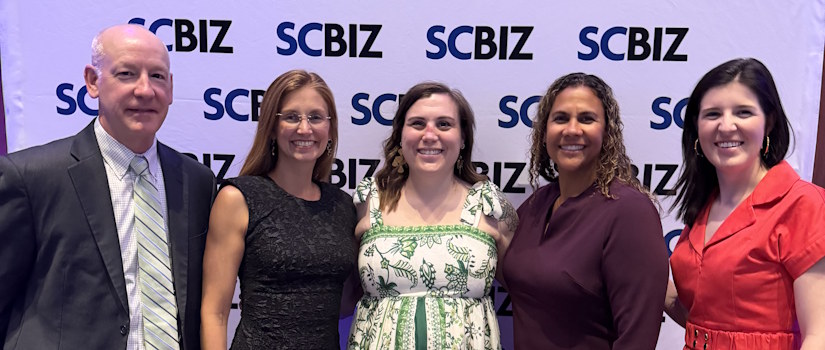
SCBiz recently recognized the state’s highest achieving women during a reception at the Columbia Metropolitan Convention Center. The event honored 100 women from across South Carolina and an array of fields for their impact in the areas of leadership, community service and mentorship. Chelsea Richard, a two-time graduate (MSPH ’15; Ph.D. in Epidemiology ’21) of the Arnold School’s Department of Epidemiology and Biostatistics, was among the honorees.
“Dr. Richard is an exceptional leader whose influence extends across education, public service and the nonprofit sector,” says close collaborator Nabil Natafgi, who is an assistant professor in the Department of Health Services Policy and Management. “She brings a rare combination of technical expertise and strategic vision to her work and the classroom where she is consistently recognized by students for her clarity, responsiveness and mentorship. Dr. Richard sets a high bar for excellence while creating a learning environment that is supportive, inclusive and empowering.”
Originally from Massachusetts, Richard has called Columbia home for 13 years. She moved South to attend USC after her first job sparked her interest in public health. Richard’s biology degree from the University of Massachusetts Boston had landed her a role contributing to a National Institutes of Health-funded study at Harvard’s teaching hospital.

Richard says the active clinical research community was infectious and her supervisor, who had a master of public health degree, opened her eyes to the fields of epidemiology and public health. Columbia’s warm climate was a welcome respite from nine-foot snow drifts, and Richard’s Master of Science in Public Health in Epidemiology program was so impactful that she continued on to pursue her doctoral degree.
The Presidential Fellow worked throughout her Ph.D. program – first at the SC Department of Public Health and then in various roles at SC First Steps and Early Childhood Education Advisory Council. During this time, she was included in Columbia Business Monthly’s Best & Brightest 35 and Under. A year ago, Richard took on the role of Vice President of Operations for the Central Carolina Community Foundation, where she leads internal operations, strategy implementation, data systems, communications oversight, and organizational effectiveness initiatives.
“My role involves everything from community assessments to strategic planning and performance measurement to technology modernization and AI implementation,” she says. “Although I no longer work in a traditional public health agency, I use my Arnold School degrees every day.”
Richard says her training in epidemiology taught her how to think critically about systems, data, and decision-making, and she regularly applies skills related to evaluation, research design, data interpretation, and translating complex information into action. Public health taught her how to work across sectors and focus on upstream solutions, which has been incredibly valuable in nonprofit leadership and systems change work.
As an Arnold School student for six years and an adjunct faculty member for five, she has made connections and found mentors across all six departments.
“One of the most important lessons I learned from my mentors was that technical expertise alone is not enough,” Richard says. “Relationships, communication and the ability to collaborate across disciplines are just as important. Their mentorship helped shape both my confidence and my approach to leadership.”
Another piece of advice she lives by is one she gives to others: finding out what you do not want to do for your career can be just as valuable as finding what you do want to do.
“Every role, project and experience teaches you something about your strengths, interests and goals,” Richard says. “Invest in relationships, especially with your fellow students, because many of the best opportunities come through the people you meet along the way.”
She also believes in the value of being your own advocate and lifting others up – through nominations for leadership positions or awards. “Get into the habit of nominating people and tell them that you see and value in them,” Richard says.
In looking back at the role USC has played in helping her make an impact in her day-to-day work, Richard also looks beyond the technical skills and knowledge to the bigger picture.
“One of the things I value most about the Arnold School is that it prepared me not only for a job, but for a career focused on continuous learning and public impact,” she says. “The foundation I received there has allowed me to work across research, government, higher education, and philanthropy while staying rooted in the core principles of public health.”